NAC Network Access Control
Network Access Control solutions built for the next generation of networks.
What is Network Access Control (NAC)?
Network Access Control (NAC) bridges several different security techniques to provide a unified approach to network access, be it wired or wireless. Endpoints, such as corporate laptops and mobiles, are often deployed with anti-virus software and users undergo an authentication process to access critical resources.
NAC combines these technologies and as a device connects to the network it is able to combine user authentication with device verification. In this way, NAC can be used to limit network resources to authorised users, and to ensure that devices that do connect to the network meet certain requirements – such as having the latest anti-virus software, no known vulnerabilities and are corporate-owned rather than personal devices.
Why is it important to have a NAC solution?
With organisations now having to account for exponential growth of mobile devices accessing their networks and the security risks they bring, it is critical to have the tools that provide the visibility, access control, and compliance capabilities that are required to strengthen your network security infrastructure.
A NAC system can deny network access to noncompliant devices, place them in a quarantined area, or give them only restricted access to computing resources, thus keeping insecure nodes from infecting the network.
What are the general capabilities of a NAC solution?
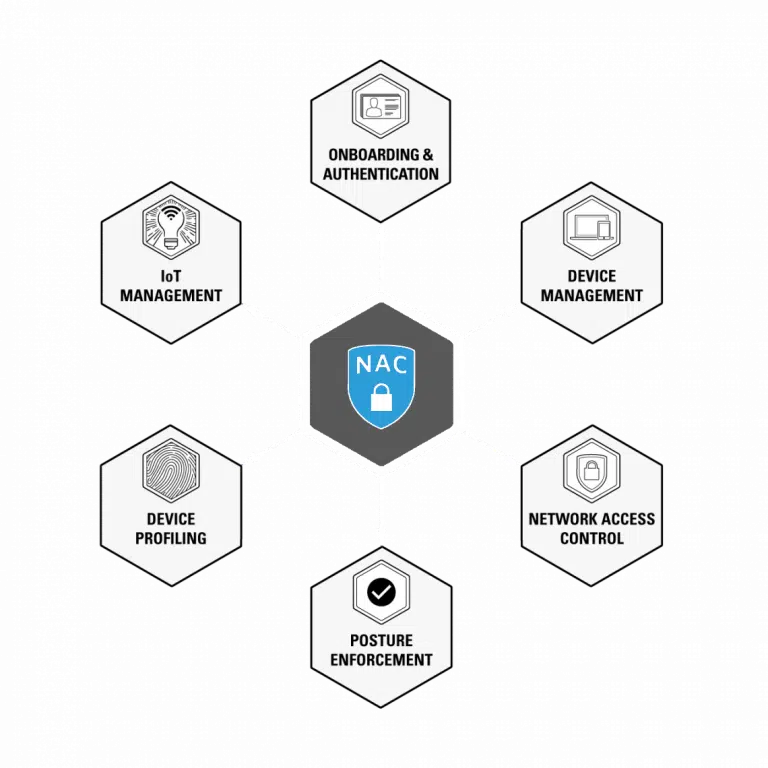
NAC solutions help organisations control access to their networks through the following capabilities:
- Policy lifecycle management: Enforces policies for all operating scenarios without requiring separate products or additional modules.
- Profiling and visibility: Recognises and profiles users and their devices before malicious code can cause damage.
- Guest networking access: Manage guests through a customisable, self-service portal that includes guest registration, guest authentication, guest sponsoring, and a guest management portal.
- Security posture cheque: Evaluates security-policy compliance by user type, device type, and operating system.
- Incidence response: Mitigates network threats by enforcing security policies that block, isolate, and repair noncompliant machines without administrator attention.
Bidirectional integration: Integrate with other security and network solutions through the open/RESTful API.
Why choose SR Cloud Solutions?
SR Cloud Solutions has a 25-year track record of supplying managed security services to many organisations in different industries.
- The best technology – highest levels of accreditation with the world’s leading vendors such as Cisco, Fortinet, and Palo Alto.
- Skills and expertise with a UK-based 24/7 Security Operations Centre (SOC).
- We are a Joscar accredited business which means we are certified to work with leading defense companies who require the highest standards of cyber security.
- We are experts in Cloud infrastructures such as Microsoft Azure so we can provide expert security consultancy on hybrid cloud environments and how best to secure and monitor those environments including Cloud Governance.
Book a meeting with one of our consultants to learn more or read on more below to find out more about our NAC Solutions.
Features and Benefits of NAC

Increased network visibility
The expansion of remote working, BYOD, third-party collaborations and IoT connectivity poses severe problems for network managers. The proliferation of devices and users is hard to map and monitor, making complete network visibility challenging to achieve.
NAC solutions solve this issue by mapping every device that connects to a network and implementing policies covering every authorised user.

Total network visibility
NAC implementations make networks more legible for corporate network managers. Security teams can map out what devices are connected and the contours of the network perimeter.
They can identify threats and launch mitigation actions based on this information before they cause any damage.

Instant user profiling
When users request remote access to NAC portals, the system immediately checks their credentials. NAC software can exclude unknown devices and individuals by comparing this data with centrally held resources.

Network management
In some cases, NAC tools can assist with network management tasks such as load balancing and resource allocation. The need to update admission policies also encourages regular protocol monitoring, prompting security teams to update access strategies.

Improved cybersecurity
The threat from cyberattacks grows constantly. Corporate resources are exposed to malware, ransomware, and DDoS attacks, while hackers continuously seek access to sensitive data that they can sell on the Dark Web.
NAC solutions minimize these threats by excluding unauthorised or suspicious actors and limiting what users can do to achieve network access.

More effective compliance
Regulators are becoming stricter about how companies protect client information, especially where payment and personal information are concerned. Companies with solid records of compliance with security regulations benefit from a trust dividend and reduce the risk of losses associated with data theft.
NAC can assist with both tasks by following gold-standard security compliance across all network endpoints.

Internal access management
When corporate networks grant user access, NAC tools determine what they can do. Sensitive resources like client databases can be kept off-limits to unauthorised users. Malicious actors will also struggle to move laterally throughout networks, limiting the dangers posed by malware attacks.

Guest networking management
Network Access Control solutions also allow companies to admit guest users securely. Secure guest access makes it possible to collaborate with partners and contractors while keeping security threats low.

Join Other Leading Companies Who Trust SR Cloud Solutions


Frequently Asked Questions
The name “Network Access Control” is almost self-explanatory. At its simplest, NAC solutions provide a way to manage access to network resources. It makes all devices and users visible to network managers and allows technicians to enforce security policies across every part of corporate networks.
Network Access Control generally includes tools that authenticate and authorize network users to access specific resources. These fundamental capabilities combine with threat response methods, including quarantine, access denial, or restricted access.
NAC isn’t wholly new. Standards like IEEE 802.1X and WPA have protected networks for decades. However, NAC solutions transcend older methods, providing security tools relevant to distributed, constantly changing networks linked to IoT and Cloud resources.
NAC systems allow companies to set finely calibrated access policies when implemented correctly. They can determine exactly how each user moves around networks and which resources they can access. They can monitor users and devices for threats and eliminate malicious actors before they cause damage. And they can do so without compromising efficiency or convenience.
NAC solutions function by establishing which devices and users are authorised to connect to wired and wireless networks. Security teams devise a protocol that forms the basis of authorization policies, and specialist software applies those protocols every time a connection request is received.
NAC systems refer to third-party authentication services when they receive access requests and establish user permissions. When the system authenticates users, it creates secure connections that resemble classic Virtual Private Network (VPN) tunnels.
NAC tools may also determine which resources are available to corporate network users. Security policies can set out different access tiers dependent upon user roles, and NAC software can make it impossible for users to move outside their allotted permissions.
Managing BYOD work arrangements
Remote working, mobile devices, and Bring-Your-Own-Device practices have become much more common in recent years. That’s good news for flexible working and collaboration but potentially leads to expanded threat surfaces and network management issues. NAC allows security teams to log BYOD authorisations and only authenticated devices to access resources.
Safe collaboration with corporate partners
Working with contractors, guests, and external partners is a regular part of modern work. But network security problems can arise when you bring in third parties to access corporate resources. NAC solutions work around this by authorising third parties seeking access to your data, allowing efficient collaboration without posing undue risks.
Incident response
When cyberattacks happen, NAC can spring into action. Companies can set up NAC applications to deliver threat response data to third-party security partners, facilitating immediate mitigation measures. Any endpoints affected by attacks can be neutralised and quarantined, and lateral movement throughout networks can be restricted.
Handling IoT-based systems
The Internet-of-Things has become a vital tool for companies in diverse sectors, with IoT devices like automated equipment, sensors, smart grids, and even IoT-connected vehicle fleets all featuring. NAC can connect large numbers of IoT devices securely and systematically, ensuring that no rogue devices are left unmapped — also applying to the proliferation of medical devices connected to the IoT. Flows of sensitive data can be regulated and protected via adaptive NAC solutions.
Security compliance
NAC is also a valuable tool to ensure compliance with relevant cybersecurity regulations. Network security policies can be integrated into GDPR or HIPAA compliance plans, providing evidence that networks meet external standards.
There are many NAC packages around and an almost infinite number of ways to configure them. However, it helps to simplify things by dividing them into two major types:
Pre-admission
Pre-admission NAC technology assesses, authenticates, and admits users when they seek to connect with corporate networks. Everything happens before users obtain access. This system stores user credentials on secure databases and access protocols specify requirements that devices need to meet before entry is permitted. Third-party authentication services are generally also used to provide extra assurance via MFA.
Post-admission
Post-admission NAC is a little different. In this case, pre-admission authentication may remain. However, post-admission network security infrastructure monitors what users can do once they access corporate resources. Internal firewalls segregate network resources, while security protocols ensure users only access data corresponding to their privileges. When endpoints try to breach those privileges, post-admission NAC systems will shut them down and deny access.
Network perimeters continue to expand and mutate. Edges are becoming more chaotic and unpredictable as increasing mobile devices connect from multiplying locations. Threat surfaces have also expanded, posing significant threats to companies that fear data theft and other forms of cyberattack.
That’s why Network Access Control is crucially important. Individual and corporate data has never been more critical, yet the world has never been more connected. This connectivity leaves networks acutely vulnerable to attacks, while managers must meet increasingly complex compliance requirements.
NAC offers a simplified route to compliance while locking down sensitive resources and ensuring network access for those who need it.
Speak to one of our security EXPERTS
Our team is available for a quick call or video meeting. Let's connect and discuss your security challenges, dive into vendor comparison reports, or talk about your upcoming IT-projects. We are here to help.